Shivam Bhandari
Data Scientist
5 min read

A shutdown rarely gets delayed because nobody knows how to replace a valve. More often, it gets delayed because nobody is completely sure they have identified the right spare. The ERP system shows several possible matches. The descriptions look close. One record includes a drawing. Another references an old supplier. A third appears to be a duplicate created years ago during a system migration.
At that point, the challenge is no longer finding information. The challenge is deciding which information to trust. This is where many industrial AI initiatives in energy operations run into trouble. The promise is familiar: smarter search, faster recommendations, better inventory visibility, improved procurement decisions, and fewer delays during maintenance. All of that is possible. But only if the data underneath the AI is reliable enough to support real operational decisions.
Most operators do not struggle because they lack information. They struggle because their information is fragmented, inconsistent, or incomplete. A spare part record may exist in the ERP. The drawing may sit in a document repository. The certificate may be attached to an old purchase order. Revision history may be unclear. The most useful context may still reside with a planner, engineer, or warehouse supervisor who has worked with that asset for years.
That may work for a while. But when the person changes roles, retires, or the site needs to make a decision quickly during a shutdown, the weakness in the data becomes impossible to ignore.
ERP Data Was Built for Transactions, Not Engineering Confidence
ERP systems do what they were designed to do. They manage stock, suppliers, purchasing, quantities, and commercial history. The problem begins when a material master is treated as a complete engineering definition of a spare part.
Take a simple record:
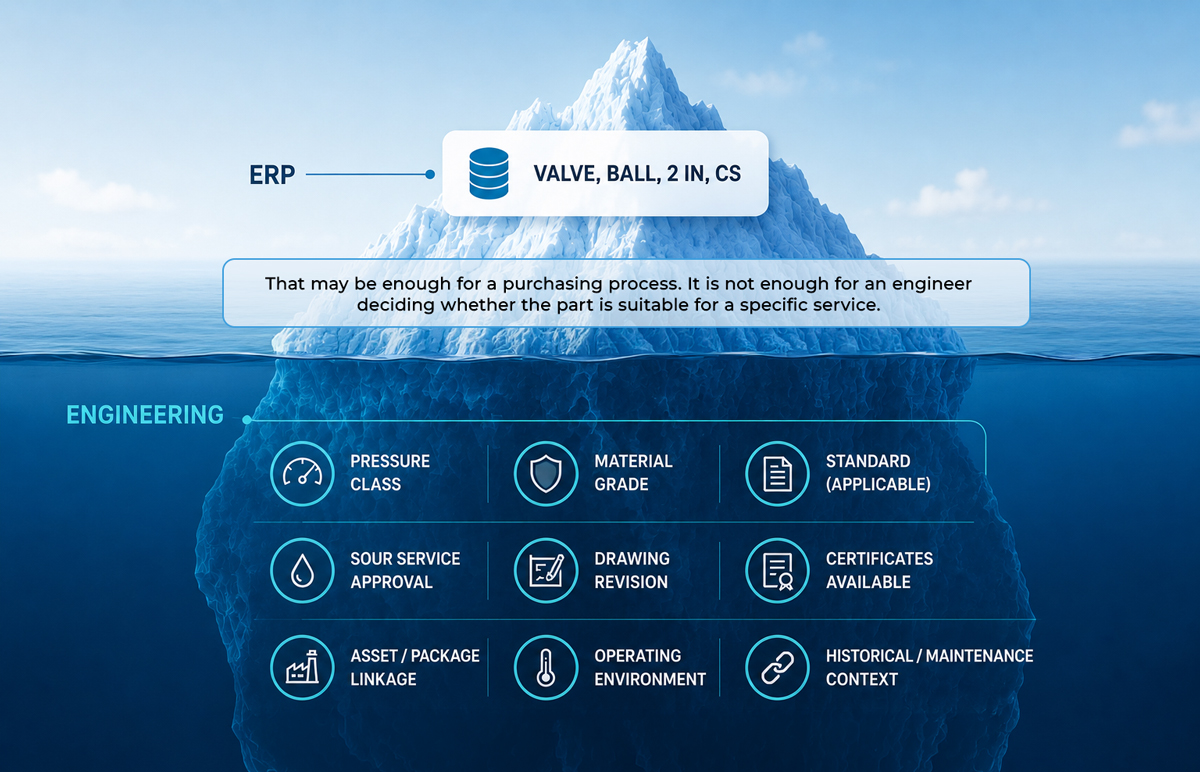
VALVE, BALL, 2 IN, CS
That may be enough for a purchasing process. It is not enough for an engineer deciding whether the part is suitable for a specific service. What pressure class applies? Which material grade is required? Which standard governs the part? Is it approved for sour service? What drawing revision defines it? Are the certificates available? Is it linked to a specific asset, package, or operating environment?
These details are not administrative extras. They are the information that determines whether the part can actually be used. This is why AI cannot rely on short ERP descriptions alone. A model can compare words and identify similar records, but similarity is not the same as suitability. In energy operations, that difference matters.
Duplicate Records Are Easy to Find and Hard to Confirm
Most large energy operators have duplicate spare part records. They build up over time through acquisitions, ERP migrations, supplier changes, emergency purchases, and inconsistent naming across sites.
On the surface, this looks like an ideal AI use case. A system can scan thousands of records and quickly flag possible duplicates. That is useful. It saves time. It gives teams a starting point. But duplicate identification is not the same as duplicate confirmation.
Two records may look almost identical while differing in pressure rating, material specification, coating, certification requirement, or approved service condition. A gasket can share the same nominal size and still be wrong for the application. A valve can have a similar description and still not be interchangeable.
Reducing duplicates sounds straightforward until someone discovers that two seemingly identical records are not actually interchangeable in service. A cleaner database is valuable only if it also increases confidence.
The goal is not simply to remove records. The goal is to know which parts are genuinely interchangeable and to preserve the evidence behind that decision.

Traceability Is Where Trust Comes From
When engineers approve a spare part for critical service, they usually do not rely on a short description. They look for evidence. Drawings. Specifications. Revision history. Certificates. Inspection reports. Applicable standards. Supplier documentation. Approval records.
That evidence gives context to the part. It explains why the part is acceptable, not just what it is called. This is where industrial AI needs to behave differently from consumer AI. In many consumer applications, a fast answer is enough. In energy operations, people need an answer they can check, defend, and act on.
A recommendation without traceability is difficult to trust. A recommendation connected to engineering evidence is much more useful. The best industrial AI tools should not simply generate answers. They should help users understand where those answers came from.
Data Quality Does Not Stay Fixed
Cleaning spare part data once can help. But without governance, the same issues return.
New suppliers are added. Emergency purchases create rushed records. Drawings change. Documents are uploaded with inconsistent naming. Old records are copied because it is faster than creating new ones properly. Slowly, the data starts to drift. This is why governance matters. Not as a theoretical exercise, but as a practical way to stop the same problems from coming back.
What Strong Spare Part Data Governance Looks Like
1
Clear naming rules
Standardize how parts are described so records stay consistent across sites, systems, and acquisitions.
2
Required engineering attributes
Capture pressure class, material grade, governing standards, and service conditions, not only commercial fields.
3
Document and revision control
Keep drawings, certificates, and specifications linked to the correct part and the correct revision.
4
Approval workflows and ownership
Define who verifies data and who owns the master record, and keep what is inferred separate from what is verified.
It also means separating what has been inferred from what has been verified. That distinction is important. A material grade extracted from a document is useful. A material grade reviewed and approved for a specific application carries a different level of confidence. Industrial AI should preserve that difference, not flatten everything into one answer.
The Foundation Comes Before the AI
At Immensa, we help energy operators build the spare part data foundation that makes industrial AI practical. That work starts by connecting fragmented information across ERP systems, drawings, specifications, standards, certificates, supplier documents, inspection records, and historical asset data.
The aim is not just to clean records. It is to create structured, traceable engineering data that teams can use with confidence. AI helps accelerate this process. It can read messy descriptions, extract attributes, compare records, identify inconsistencies, and highlight areas that need expert review.
But AI does not replace engineering evidence. It helps organize it. For energy operators, this foundation supports faster spare part identification, better inventory visibility, more reliable sourcing decisions, stronger compliance, and lower downtime risk during shutdowns and outages.
It also supports digital inventory strategies. Before an operator can evaluate sourcing alternatives, repair options, inventory optimization, or digital manufacturing pathways, it needs confidence in the underlying engineering data.
The Bottom Line
That part of the work may not sound as exciting as AI. But it is often the part that determines whether AI delivers value.
Because when a critical spare is needed, nobody cares how advanced the system sounds. They care whether the part is right. And whether they can trust the answer.
Build the Data Foundation Before You Scale AI
Immensa helps energy operators turn fragmented spare part records into structured, traceable engineering data that teams can trust during critical decisions.